 Medically Reviewed By: Dr Paul Lim – MBBS, M.Med (Int Med), MRCP (UK), FAMS (Cardiology)
HOMA-IR Test Insulin Resistance Blood Test in Singapore
HOMA-IR — the Homeostatic Model Assessment of Insulin Resistance — is a simple fasting blood test that estimates how well your body responds to insulin. Insulin resistance is an early, often silent step towards type 2 diabetes and is associated with high blood pressure, abnormal cholesterol and heart disease. It is a supplementary marker — read alongside the standard tests — that can be raised before fasting glucose changes.

Clinical Experience
Your HOMA-IR Result Is Interpreted by Dr Paul Lim
Senior Consultant Cardiologist & Cardiac Electrophysiologist
Dr Paul Lim is a Senior Consultant Cardiologist who reviews your HOMA-IR result in the context of your full cardiovascular risk — your blood pressure, cholesterol, weight, family history and lifestyle — and explains what it means for you and what, if anything, to do about it. He completed advanced fellowship training at Barts Heart Centre, London under Singapore’s HMDP award.
- MBBS (Singapore)
- M.Med (Int Med)
- MRCP (UK)
- FAMS (Cardiology)
- Fellow, European Society of Cardiology (FESC)
- Fellow, American College of Cardiology (FACC)
- Fellow, Heart Rhythm Society (FHRS)
What Is HOMA-IR?
HOMA-IR — the Homeostatic Model Assessment of Insulin Resistance — is a number worked out from two fasting blood measurements: your fasting glucose and your fasting insulin. Together they estimate how well your body is responding to insulin.
Insulin is the hormone that moves sugar out of your blood and into your cells for energy. When your cells stop responding well to it — called insulin resistance — your pancreas compensates by making more insulin to keep blood sugar normal. A raised HOMA-IR reflects that extra insulin workload. Because this can build up quietly over years, HOMA-IR can reveal a problem while a standard fasting glucose or HbA1c still looks normal — and, unlike some inherited risks, it can often be improved.
What a HOMA-IR Result Adds
Insulin resistance is associated with metabolic syndrome and, over the long term, a higher risk of type 2 diabetes and heart disease. HOMA-IR is best thought of as a supplementary marker — it adds context to, rather than replaces, the established tests. A result may help a doctor:
- Gauge whether insulin resistance may be contributing to your metabolic picture
- Put your established results — blood pressure, weight, fasting glucose, HbA1c and a lipid panel — in context (these remain the main measures used to judge risk)
- Provide a baseline you can re-check to see whether lifestyle changes are reducing insulin resistance over time
Worth knowing: major diabetes guidelines do not recommend HOMA-IR or fasting insulin for routine risk screening — standard assessment uses fasting glucose, HbA1c, a lipid panel, blood pressure and BMI — and there is no single agreed cut-off for HOMA-IR. It is therefore best used as additional information in selected situations, interpreted by a doctor alongside these established tests rather than as a stand-alone heart-risk test.
The upside is that insulin resistance can often be improved through diet, exercise and weight loss, so a raised result is an opportunity to act early — for example alongside a CT calcium score or a full heart screening.
Who Should Have a HOMA-IR Test?
A HOMA-IR test is especially worth considering if you have:
- Central or abdominal weight, or a raised BMI
- A family history of type 2 diabetes
- Raised blood pressure, high triglycerides or low HDL cholesterol
- Borderline or impaired fasting glucose
- Polycystic ovary syndrome (PCOS), which is closely linked to insulin resistance
- A wish to understand your cardiometabolic risk as part of a thorough health check
Not sure whether the test is right for you? Dr Paul Lim can advise during a consultation and arrange it where appropriate.
What to Expect
The test itself is quick and straightforward — the main thing is to come fasted.
- Fasting is required — avoid food and sugary drinks for about 8 hours beforehand. Water and your usual medicines are generally fine; let us know what you take.
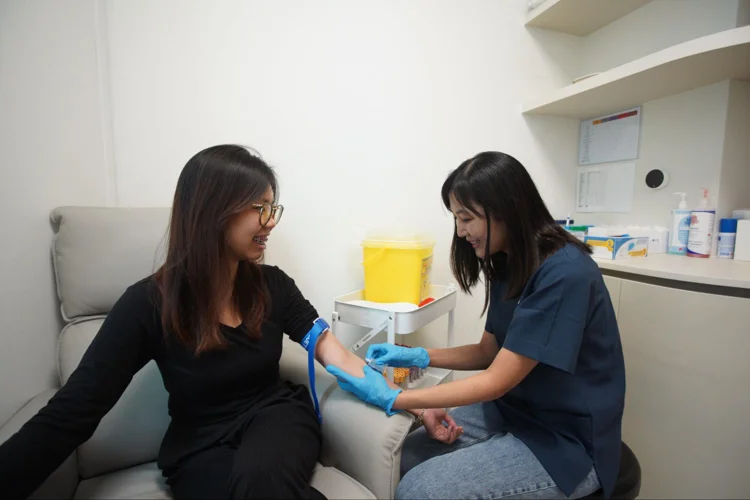
- A member of our clinical team takes a single blood sample from a vein in your arm. It takes only a few minutes.
- The laboratory measures your fasting glucose and fasting insulin, and the HOMA-IR index is calculated from them.
- Dr Paul Lim reviews the result alongside your blood pressure, cholesterol, weight, family history and lifestyle, and explains what it means for you.
- If your HOMA-IR is raised, he will discuss practical steps to improve it and lower your overall cardiovascular risk.
Why Do Your HOMA-IR Test with Us?
An Early Metabolic Signal
HOMA-IR can be raised before standard glucose tests change — a supplementary signal of insulin resistance, read alongside (not instead of) those tests.
Interpreted in Context
Dr Paul Lim explains your result alongside your established tests and overall metabolic picture — not as a stand-alone score or a number handed to you.
A Risk You Can Improve
Unlike inherited risks, insulin resistance often responds to lifestyle changes and treatment — so a raised result is a chance to act.
Track Your Progress
Because insulin resistance can change, HOMA-IR can be re-checked over time to see whether your changes are working.
Transparent Pricing
Our HOMA-IR and consultation fees are published below, so you know the cost before you book.
Two Locations
Available at our Jurong and Orchard clinics.
Wondering if you should check your insulin resistance? Speak with Dr Paul Lim.
HOMA-IR Test Cost in Singapore
All fees are inclusive of GST.
| Service | Price |
|---|---|
| Test | |
| HOMA-IR — fasting insulin & glucose | S$87.20 |
| Basic Heart Check-Up Package An all-inclusive screening — includes fasting insulin/HOMA-IR, a cardiologist consultation & review, a comprehensive blood panel, a resting ECG and a treadmill stress test | S$368 |
| Consultation | |
| First Consultation with Cardiologist (Jurong) | S$130.80 |
| Follow-up Consultation with Cardiologist (Jurong) | S$98.10 |
| First Consultation with Cardiologist (Orchard) | S$272.50 |
| Follow-up Consultation with Cardiologist (Orchard) | S$163.50 |
A consultation with the cardiologist is required so the test can be properly indicated and your result interpreted in the context of your overall cardiometabolic risk.
Fasting insulin and glucose for HOMA-IR are included in our heart screening packages. Because insulin resistance can change over time, HOMA-IR can be repeated to track whether lifestyle changes or treatment are working.
Book a Cardiologist Appointment
Contact us to schedule a consultation or to find out more about our cardiac services.
Send Us a Message

HOMA-IR FAQ
What is HOMA-IR?
HOMA-IR, short for the Homeostatic Model Assessment of Insulin Resistance, is a number calculated from two fasting blood measurements — your fasting glucose and your fasting insulin. Together they estimate how well your body responds to insulin. A raised HOMA-IR suggests insulin resistance, meaning your cells respond less well to insulin and your pancreas has to make more of it to keep blood sugar normal.
Why does insulin resistance matter for my heart?
Insulin resistance is associated with metabolic syndrome — the cluster of raised blood pressure, abdominal weight, abnormal cholesterol and high blood sugar linked to a higher risk of heart attack and stroke — and with type 2 diabetes over the long term. It can be present before fasting glucose rises, but HOMA-IR is a supplementary marker rather than a stand-alone risk test, and is best read alongside your established results.
Is HOMA-IR a routine or guideline-recommended test?
No. Major diabetes guidelines do not recommend HOMA-IR or fasting insulin for routine screening — standard assessment uses fasting glucose, HbA1c, a lipid panel, blood pressure and BMI. HOMA-IR is best seen as a supplementary marker in selected situations, interpreted alongside these established tests, and there is no single agreed cut-off for it. Dr Paul Lim can advise whether it adds anything useful in your case.
Who should have a HOMA-IR test?
A HOMA-IR test is worth considering if you carry weight around the middle or have a raised BMI, have a family history of type 2 diabetes, have raised blood pressure, high triglycerides or low HDL cholesterol, have borderline fasting glucose, or have polycystic ovary syndrome (PCOS), which is closely linked to insulin resistance. It is also useful if you simply want to understand your cardiometabolic risk. Dr Paul Lim can advise whether the test is appropriate for you.
Do I need to fast for a HOMA-IR test?
Yes. HOMA-IR relies on fasting glucose and fasting insulin, so you should avoid food and sugary drinks for about 8 hours beforehand. Water and your usual medicines are generally fine, but let us know what you take so we can advise. Fasting is essential for an accurate result.
How is the test done?
It is a single blood sample taken from a vein in your arm by a member of our clinical team, and takes only a few minutes. The laboratory measures your fasting glucose and fasting insulin, and the HOMA-IR index is calculated from those two values.
How often should HOMA-IR be checked?
Unlike an inherited marker, insulin resistance can change over time, so HOMA-IR can be repeated to track progress. If your result is raised and you make lifestyle changes or start treatment, your cardiologist may re-check it after a few months to see whether things are improving.
Can insulin resistance be improved?
Yes. Unlike some inherited risks, insulin resistance often responds well to changes you can make — losing excess weight, increasing physical activity, improving diet, and treating related conditions such as high blood pressure and abnormal cholesterol. Dr Paul Lim will explain what your result means and the practical steps that can help lower your overall cardiovascular risk.
How much does a HOMA-IR test cost in Singapore?
At our clinic a HOMA-IR test (fasting insulin and glucose) is S$87.20, inclusive of GST. A cardiologist consultation is also required (S$130.80 first / S$98.10 follow-up at Jurong; S$272.50 first / S$163.50 follow-up at Orchard, inclusive of GST). Fasting insulin and glucose for HOMA-IR are also included in our heart screening packages. See the fee table above.