 Medically Reviewed By: Dr Paul Lim – MBBS, M.Med (Int Med), MRCP (UK), FAMS (Cardiology)
CT Calcium Score Coronary Calcium Scan in Singapore
A CT calcium score is a quick, low-dose CT scan that measures calcified plaque in the arteries supplying your heart. Your result is an Agatston score, a number for how much has built up, years before any symptoms appear. No injection or contrast dye is needed. Unsure what your score means? Dr Paul Lim will put it in the context of the rest of your risk, warmly and patiently.
Reviewed by Dr Paul Lim Chun Yih
Senior Consultant Cardiologist

Clinical Experience
Your Calcium Score Is Reviewed by Dr Paul Lim
Senior Consultant Cardiologist & Cardiac Electrophysiologist
Dr Paul Lim is a Senior Consultant Cardiologist who reviews your CT calcium score and explains what it means for your heart, as part of a full cardiovascular risk assessment. He completed advanced fellowship training at Barts Heart Centre, London under Singapore’s HMDP award.
- MBBS (Singapore)
- M.Med (Int Med)
- MRCP (UK)
- FAMS (Cardiology)
- Fellow, European Society of Cardiology (FESC)
- Fellow, American College of Cardiology (FACC)
- Fellow, Heart Rhythm Society (FHRS)
What Is a CT Calcium Score?
A CT calcium score — also called a coronary artery calcium (CAC) score or coronary calcium scan — is a low-dose computed tomography (CT) scan of the heart. It looks specifically for calcified plaque in the coronary arteries, the vessels that supply blood to the heart muscle.
Calcium in these arteries is a marker of atherosclerosis — the gradual build-up of fatty, hardened cholesterol plaques that underlies most heart attacks. The scanner measures how much calcium is present and converts it into a single number, the Agatston score. The higher the score, the more plaque has accumulated and the greater your risk of significant coronary artery disease. Because plaque builds up silently over years, a calcium score can flag risk long before any symptoms appear.
What Your Calcium Score Means
Results are reported on the Agatston scale. As a general guide:
| Agatston score | Plaque burden | What it generally suggests |
|---|---|---|
| 0 | No detectable calcified plaque | Very low short-term risk of a heart attack |
| 1 – 10 | Minimal plaque | Low risk |
| 11 – 100 | Mild plaque | Mildly increased risk |
| 101 – 400 | Moderate plaque | Moderately increased risk |
| Over 400 | Extensive plaque | High risk of coronary artery disease |
These ranges are a general guide only. Your score is always interpreted by a cardiologist alongside your age, sex and other risk factors — a given number can mean different things for a younger versus an older person. What matters most is what the result means for your care, and whether it changes the case for preventive treatment.
Who Should Consider a Calcium Score?
A calcium score is most helpful for adults without symptoms who sit at intermediate cardiovascular risk, where the result can tip a treatment decision one way or the other. It is often considered if you:
- Have a family history of early heart disease
- Have high cholesterol, high blood pressure or diabetes
- Are a current or former smoker
- Are uncertain about starting cholesterol-lowering medication and want objective evidence to guide the decision
- Want a clearer picture of your heart risk as part of a heart screening
A calcium score is generally not needed if you already have a diagnosis of coronary artery disease, stents or bypass surgery, as the result would not change your management. It is also not used to investigate acute chest pain — if you have chest pain at rest or on exertion, seek prompt medical assessment instead.
What to Expect
The scan is fast, comfortable and needs very little preparation.
- No fasting and no dye. Unlike a CT coronary angiogram, a calcium score needs no injection and no contrast. It helps to avoid caffeine and smoking for a few hours beforehand so your heart rate stays steady.
- A few ECG electrodes are placed on your chest so the scanner can time its images to your heartbeat.
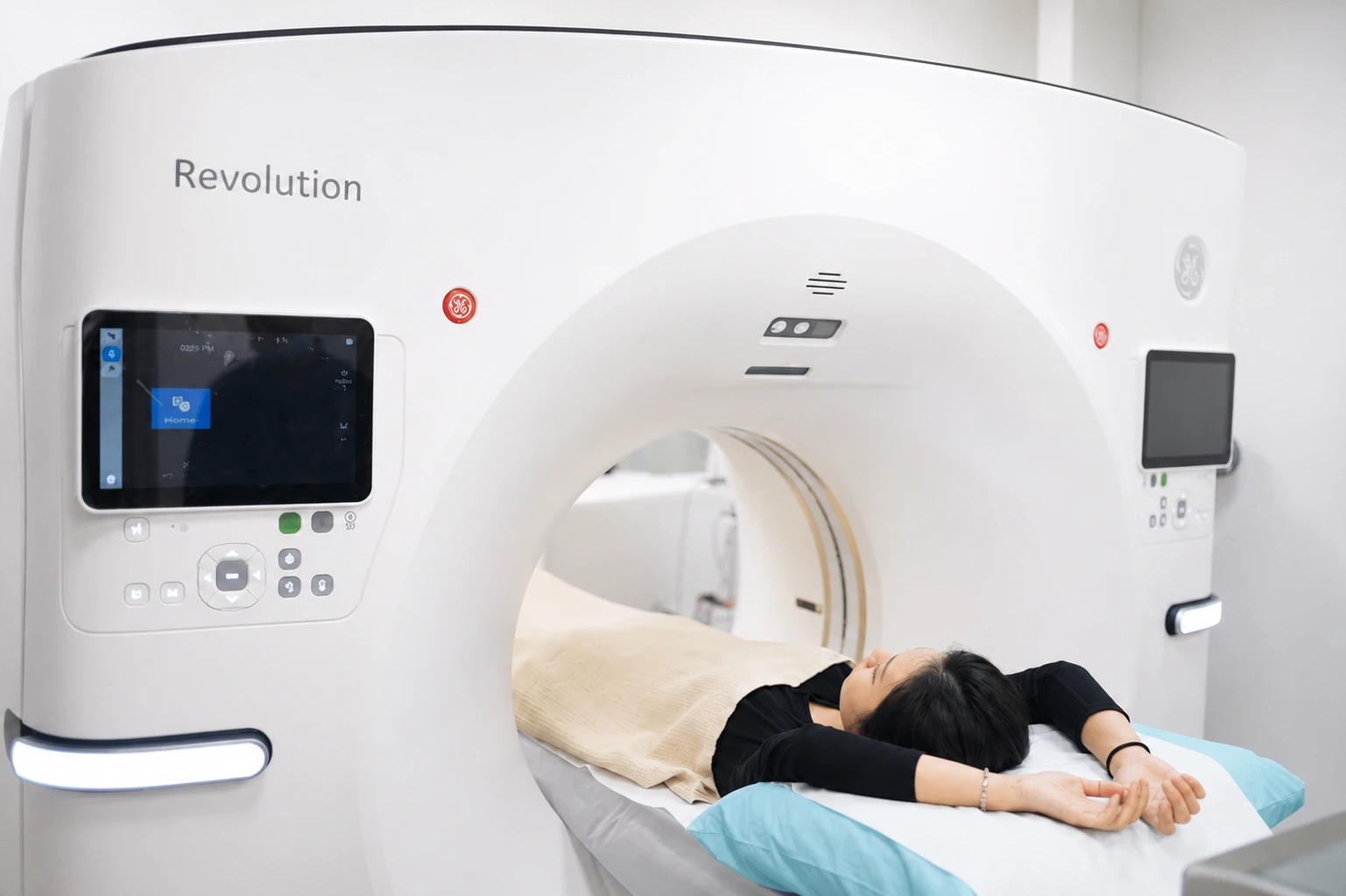
- You lie on your back on the CT table and the bed moves slowly through the ring-shaped scanner. You will be asked to hold your breath for a few seconds during the scan.
- The scan itself is over in minutes, with the whole visit taking around 10 minutes.
- The images are scored using the Agatston method, and Dr Paul Lim reviews and explains your result and what it means for your heart.
Why Do Your Calcium Score with Us?
Reviewed by a Cardiologist
Your score is interpreted in context and explained by Dr Paul Lim, a Senior Consultant Cardiologist — not just a number on a report.
Low-Dose, No Dye
A quick, contrast-free, low-dose scan with no needles — and no downtime afterwards.
A Plan, Not Just a Score
We use your result to shape a clear, personalised prevention plan, from lifestyle steps to medication where appropriate.
Friendly & Caring Service
Our team takes the time to put you at ease and explain your results clearly, so you leave understanding what they mean.
Transparent Pricing
Our scan and consultation fees are published below, so you know the cost before you book.
On-Site CT Imaging
The scan is done at our CT suite at the Orchard clinic — no separate imaging-centre appointment.
Wondering if a calcium score is right for you? Speak with Dr Paul Lim.
CT Calcium Score Cost in Singapore
All fees are inclusive of GST. The scan is offered at our Orchard clinic.
| Service | Price |
|---|---|
| Test | |
| CT Calcium Score | From S$403.30 |
| Related Test | |
| CT Coronary Angiogram (CTCA) Includes a calcium score; also shows artery narrowing | From S$1,384.30 |
| Consultation | |
| First Consultation with Cardiologist (Jurong) | S$130.80 |
| Follow-up Consultation with Cardiologist (Jurong) | S$98.10 |
| First Consultation with Cardiologist (Orchard) | S$218 |
| Follow-up Consultation with Cardiologist (Orchard) | S$163.50 |
| Also Available in a Heart Screening Package | |
| Advanced Heart Check-Up | S$878 |
| Comprehensive Heart Check-Up | S$1,578 |
| Full Heart Check-Up | S$1,688 |
A consultation with the cardiologist is required so the scan can be properly indicated and your score explained. You can consult Dr Paul Lim at either our Jurong or Orchard clinic; the CT scan itself is performed at our Orchard clinic. If you already have a referral letter from another doctor, the CT calcium score can be arranged without a separate consultation. Package prices shown are all-inclusive — every test in that package plus the consultation and a results review with Dr Paul Lim. If you need a closer look at the artery walls, a CT coronary angiogram (CTCA) also includes a calcium score and shows any artery narrowing in detail.
Book a CT Calcium Score Scan
Arrange a calcium score scan at the Orchard clinic, next to the CT suite.
Send Us a Message

Where to Get a CT Calcium Score in Singapore
CT imaging is carried out at the Orchard clinic. Consultations and follow-up are available at both locations.

Opening Hours
| Monday – Friday | 8:30 AM – 5:30 PM |
| Saturday | 8:30 AM – 12:30 PM |
| Sunday & Public Holidays | Closed |
By Appointment Only
CT Calcium Score FAQ
What is a CT calcium score?
A CT calcium score — also called a coronary artery calcium (CAC) score or coronary calcium score — is a quick, low-dose CT scan that measures the amount of calcified plaque in the arteries supplying your heart. The result is given as an Agatston score: a higher number means more plaque and a higher risk of coronary artery disease. It uses no injection or contrast dye and takes about 10 minutes.
What is a good calcium score, and what does my score mean?
Scores are read on the Agatston scale. A score of 0 means no detectable calcified plaque and a very low short-term risk. 1 to 10 is minimal plaque, 11 to 100 is mild, 101 to 400 is moderate, and above 400 indicates extensive plaque and a high risk of coronary artery disease. Your score is always interpreted by a cardiologist alongside your age, sex and other risk factors. See the score guide above.
Does a calcium score of zero mean my heart is healthy?
A score of zero is reassuring and is linked to a very low risk of a heart attack over the next several years, but it is not an absolute guarantee. It only measures calcified plaque, so very early, soft (non-calcified) plaque may not be picked up. Healthy habits and managing risk factors such as cholesterol, blood pressure and blood sugar still matter.
Is a CT calcium score safe? How much radiation is involved?
It is a low-dose scan, typically around 1 millisievert — similar to a few months of natural background radiation and lower than many standard CT scans. No injection or contrast dye is used. As with any test that uses radiation, it is only recommended when the result is likely to change your care.
How do I prepare for a calcium score scan?
Very little preparation is needed. You do not need to fast, and no dye is injected. It helps to avoid caffeine and smoking for a few hours beforehand so your heart rate stays steady, and to wear comfortable clothing. You will be asked to remove metal items from your chest area before the scan.
What is the difference between a calcium score and a CT coronary angiogram?
A calcium score is a quick, contrast-free scan that measures how much calcified plaque is present and gives a risk score. A CT coronary angiogram (CTCA) uses an injection of contrast dye to produce detailed pictures of the artery walls and shows whether any narrowing is present. The calcium score is often used first for risk assessment; a CTCA gives more detail when symptoms or a high score warrant it.
Who should consider a calcium score?
It is most useful for adults with no symptoms who are at intermediate cardiovascular risk — for example those with a family history of heart disease, high cholesterol, high blood pressure, diabetes or a history of smoking — where the result helps decide whether to start or intensify preventive treatment such as cholesterol-lowering medication. It is generally not needed for people already diagnosed with coronary artery disease.
Where is the CT calcium score done?
The CT calcium score is available at our Orchard clinic, where the scan is performed on site. Dr Paul Lim reviews the images and explains your score during your consultation.
How much does a CT calcium score cost in Singapore?
At our clinic a CT calcium score is from S$403.30, inclusive of GST. A cardiologist consultation is also required (S$130.80 first / S$98.10 follow-up at Jurong; S$218 first / S$163.50 follow-up at Orchard, inclusive of GST). See the fee table above.
Who interprets my calcium score?
Your scan is reviewed and reported by Dr Paul Lim, a Senior Consultant Cardiologist, who explains what your Agatston score means for your heart and what steps, if any, are recommended.