Atrial Fibrillation (AFib)
The most common reason. Cardioversion is used to bring a fast, irregular rhythm back to normal, often when symptoms persist despite medication, or as a planned step in a rhythm-control strategy.
 Medically Reviewed By: Dr Paul Lim – MBBS, M.Med (Int Med), MRCP (UK), FAMS (Cardiology)
Electrical cardioversion is a short, planned procedure, also called DC cardioversion or 心脏电复律 (xīnzàng diàn fùlǜ). A brief, carefully timed shock resets an abnormal heart rhythm back to a normal one, most often in atrial fibrillation or atrial flutter. It is delivered while you are asleep under short sedation, so you do not feel it. Uneasy about the word “shock”, or unsure whether you need one? Dr Paul Lim can talk your concerns through with you, patiently.
Dr Paul Lim Chun Yih
Senior Consultant Cardiologist & Electrophysiologist

Senior Consultant Cardiologist & Cardiac Electrophysiologist
Dr Paul Lim subspecialises in heart rhythm disorders, performing cardioversion, catheter ablation, and pacemaker and defibrillator procedures for arrhythmia patients. He completed advanced fellowship training at Barts Heart Centre, London — one of Europe’s largest heart rhythm centres — under Singapore’s HMDP award.
Electrical cardioversion is a procedure that restores a normal heart rhythm by delivering a brief, controlled electric shock to the heart through pads placed on the chest. It is used when the heart is beating with a fast, abnormal rhythm — most commonly atrial fibrillation (AFib) or atrial flutter.
In a normal heart, each beat is triggered by an electrical signal from the heart’s natural pacemaker (the sinus node). In atrial fibrillation, disorganised electrical activity makes the upper chambers quiver instead of beating properly, so the heartbeat becomes fast and irregular. The cardioversion shock briefly interrupts this abnormal activity and gives the sinus node the chance to take over again, returning the heart to a normal (sinus) rhythm.
The shock is synchronised — the machine times it precisely to the heart’s own electrical cycle (the R wave) to deliver it safely. You are given short sedation or a brief general anaesthetic beforehand, so you are asleep and do not feel the shock. The procedure itself is very quick. Cardioversion treats the rhythm; it does not treat blocked arteries and is not a treatment for a heart attack.
In Singapore, electrical cardioversion is carried out by a heart rhythm specialist, with your heart rhythm and sedation closely monitored throughout.
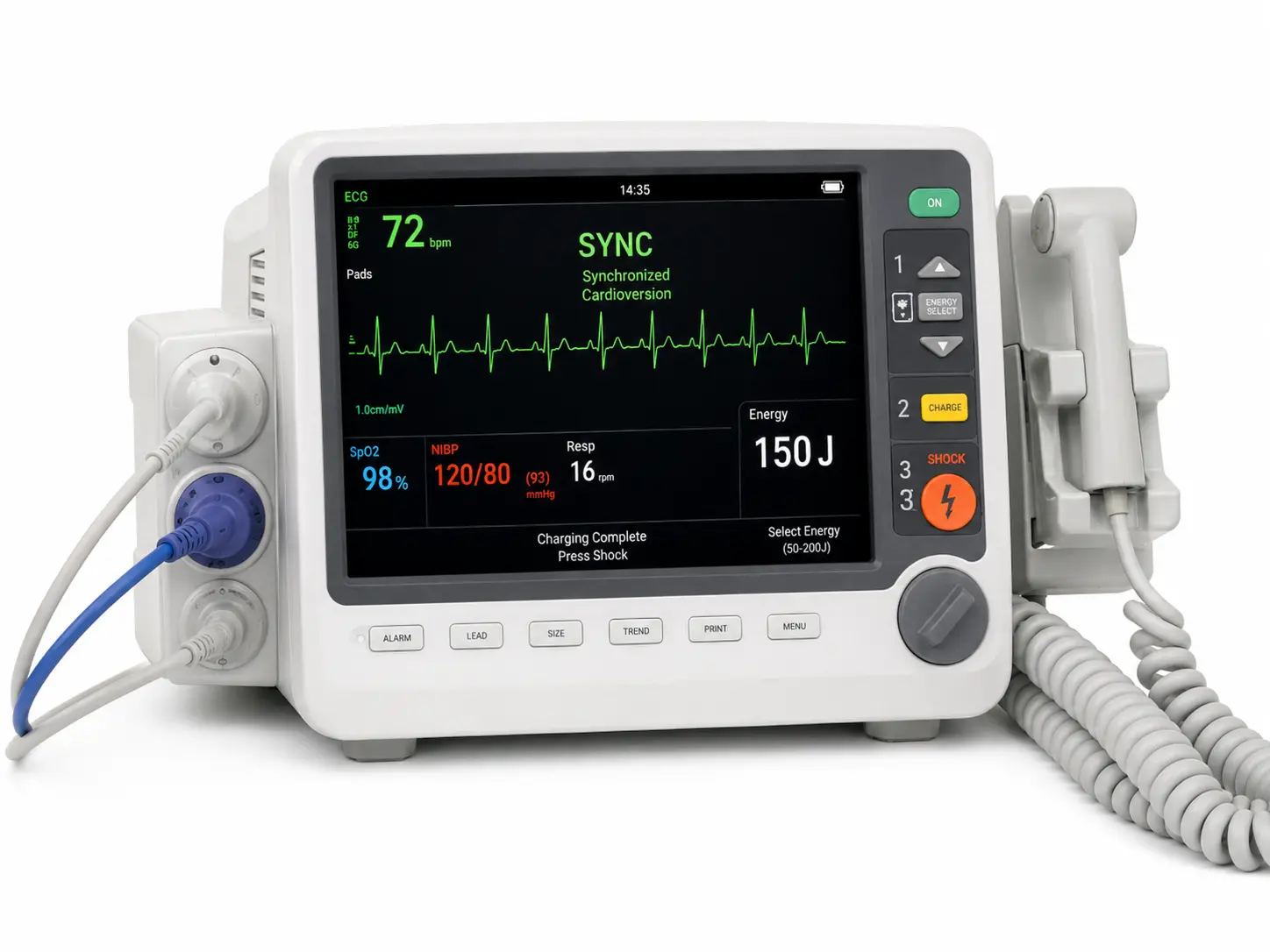
People often confuse cardioversion with defibrillation because both use an electric shock, but they are used for different situations.
| Synchronised cardioversion | Defibrillation | |
|---|---|---|
| When it’s used | A planned procedure for an organised but abnormal fast rhythm (AFib, atrial flutter, SVT, or a stable fast rhythm from the lower chambers) | An emergency for a life-threatening, chaotic rhythm (ventricular fibrillation or pulseless ventricular tachycardia) — a cardiac arrest |
| Timing of the shock | Synchronised — timed to the heart’s own R wave to avoid the vulnerable part of the cycle | Unsynchronised — delivered immediately, as there is no organised rhythm to synchronise to |
| Energy | Usually lower energy | Usually higher energy |
| Is the patient awake? | No — given as a planned procedure under sedation | No — the person is unconscious in cardiac arrest |
| Setting | Elective, in a monitored procedure area | Emergency resuscitation |
In short: cardioversion is a planned, synchronised shock for an organised abnormal rhythm, while defibrillation is an emergency, unsynchronised shock for a cardiac arrest.
Cardioversion is used to restore a normal rhythm when the heart is in a fast, abnormal rhythm — particularly when it causes symptoms such as palpitations, breathlessness, chest discomfort, tiredness, or dizziness. A specialist assessment, including an ECG, confirms the rhythm first. Common reasons include:
The most common reason. Cardioversion is used to bring a fast, irregular rhythm back to normal, often when symptoms persist despite medication, or as a planned step in a rhythm-control strategy.
A fast, more regular rhythm from the upper chambers, atrial flutter often responds well to cardioversion.
Selected fast rhythms arising from the upper chambers that do not settle with medication.
A fast rhythm from the lower chambers in a stable patient may be cardioverted under specialist care.
Cardioversion is not used for every rhythm problem. A persistently slow heartbeat is treated with a pacemaker, not a shock, and a chaotic rhythm in a collapsed patient (ventricular fibrillation) needs emergency defibrillation rather than planned cardioversion.
Been told you may need a cardioversion? Discuss your options with Dr Paul Lim.
There are two ways to convert an abnormal rhythm back to normal:
The choice depends on the rhythm, how long it has been present, your heart’s condition, and your preferences. Your specialist will recommend the most suitable approach. The same rules about blood thinners (anticoagulation) apply to both methods.
Your suitability is decided during a consultation based on your rhythm, symptoms, how long the abnormal rhythm has been present, and your overall heart health.
The most important safety step is preventing a stroke. When the heart has been in atrial fibrillation or flutter for more than about 48 hours, a small blood clot can form in the upper chamber. Restoring a normal rhythm can dislodge that clot and cause a stroke. To prevent this, current European Society of Cardiology (ESC) guidelines for atrial fibrillation recommend one of the following before an elective cardioversion:
Anticoagulation is then continued for at least four weeks afterwards, and often long term, depending on your individual stroke risk (assessed with the CHA₂DS₂-VASc score).
Cardioversion may be less suitable, or need extra preparation, if there is an untreated clot, a very enlarged upper chamber, an uncorrected cause (such as an overactive thyroid or a significant electrolyte imbalance), or if previous cardioversions have not held — in which case catheter ablation or a medication strategy may be discussed instead.
Electrical cardioversion is a short procedure carried out in a monitored area with an anaesthetist or sedation specialist present. It is not surgery and involves no cuts.
Before the procedure: You will usually be admitted on the day after fasting for about 6 hours. Your blood-thinning medication and a recent blood test are checked to confirm it is safe to proceed. A TOE scan may be done first if needed (see above). Adhesive pads are placed on your chest (and sometimes your back).
You lie on a trolley with ECG, blood-pressure, and oxygen monitoring attached, and a small drip is placed in a vein.
A short-acting sedative or brief general anaesthetic is given through the drip. You fall asleep within moments and are not aware of the shock.
Once you are asleep, the cardiologist delivers a synchronised shock through the chest pads. If the first shock does not restore a normal rhythm, one or more further shocks at a higher energy may be given.
You wake within minutes of the shock. The whole procedure usually takes only about 15 to 30 minutes from sedation to waking.
You rest and are monitored while the sedation wears off, with an ECG to confirm the rhythm. You stay overnight and go home the next day.
Most patients recover quickly. Here is what to expect after an uncomplicated electrical cardioversion.
You rest while the sedation wears off. Mild drowsiness is normal. Some people have temporary redness or mild soreness on the chest where the pads were placed.
Most patients are monitored, stay overnight, and go home the next day once the rhythm and observations are satisfactory.
Because of the sedation, do not drive, operate machinery, sign important documents, or drink alcohol. Have someone stay with you.
Most people return to normal activities and desk-based work quickly.
Continue your blood thinners and any rhythm medication exactly as prescribed — this is essential for at least four weeks, and often longer. A follow-up reviews your rhythm and medication.
Electrical cardioversion restores a normal rhythm immediately in the great majority of cases — the initial success rate for atrial fibrillation is high. However, cardioversion resets the rhythm; it does not cure the underlying tendency to the arrhythmia, so the abnormal rhythm can return over weeks or months in a proportion of patients.
To help the heart stay in a normal rhythm afterwards, your specialist may recommend:
If the rhythm does return, cardioversion can often be repeated, and your specialist will review the overall plan with you.
Electrical cardioversion is a common, well-established, and generally low-risk procedure. Serious complications are uncommon, and death from the procedure itself is very rare. The main risks are:
Dr Lim will discuss your individual risks and obtain written informed consent before the procedure.
Have questions about cardioversion? Dr Paul Lim is happy to help.
Cardioversion is one of several ways to manage an abnormal heart rhythm. Here is how it compares with the main alternatives.
| Treatment | What it does | When it is used | How it differs from cardioversion |
|---|---|---|---|
| Electrical cardioversion | A synchronised shock that resets an abnormal rhythm to normal | A planned reset of AFib, atrial flutter, or selected fast rhythms | Quick and effective at restoring rhythm, but does not stop the arrhythmia returning |
| Chemical (drug) cardioversion | Medication used to restore a normal rhythm without a shock | Selected cases, often newer-onset AFib | Avoids sedation but is generally slower and less reliable |
| Catheter ablation | Neutralises the small areas of heart tissue driving the abnormal rhythm | Recurrent or troublesome AFib, flutter, SVT, or VT, or when a longer-term solution is preferred | Aims to prevent the arrhythmia returning, rather than just resetting it. |
| Rate-control medication | Slows the heart rate without restoring a normal rhythm | When controlling the rate is the goal rather than restoring rhythm | Manages symptoms but leaves the heart in the abnormal rhythm |
| Pacemaker | Prevents the heart beating too slowly | Slow heart rhythms (bradycardia, heart block) | Treats a slow heartbeat, not a fast one — the opposite problem. (See our pacemaker page.) |
The right option depends on your specific rhythm, how often it occurs, your heart’s condition, and your preferences. Dr Paul Lim will discuss which approach is most appropriate for you.
Book a consultation to find out whether cardioversion is appropriate, and how to prepare for it.
| Monday – Friday | 8:30 AM – 5:30 PM |
| Saturday | 8:30 AM – 12:30 PM |
| Sunday & Public Holidays | Closed |
By Appointment Only
Answers to the questions patients ask most often about cardioversion, the procedure, and what to expect afterwards.
Electrical cardioversion is a short, planned procedure that uses a brief, synchronised electric shock to reset an abnormal heart rhythm — most often atrial fibrillation or flutter — back to a normal rhythm. You are asleep under sedation, so you do not feel the shock.
Both use an electric shock, but cardioversion is a planned, lower-energy shock that is synchronised to the heartbeat to treat an organised abnormal rhythm. Defibrillation is an emergency, unsynchronised, higher-energy shock used to treat a cardiac arrest.
No. You are given short-acting sedation or a brief general anaesthetic, so you are asleep for the shock and do not feel or remember it. You wake up within a few minutes.
No. Because you are asleep under sedation, you do not feel the shock. Afterwards, some people have mild redness or soreness on the chest where the pads were placed, which soon settles.
The shock itself takes only seconds. From sedation to waking up, the procedure usually takes about 15 to 30 minutes. You then rest while the sedation wears off and stay overnight before going home.
Electrical cardioversion is a common, low-risk procedure, and death from the procedure itself is very rare. The most important risk is stroke from a dislodged blood clot, which is why blood thinners and, where needed, a TOE scan are used beforehand to make it as safe as possible.
If the heart has been in an abnormal rhythm for more than about 48 hours, a blood clot can form in the upper chamber. Restoring a normal rhythm could dislodge it and cause a stroke. Blood thinners for at least three weeks before (or a TOE scan to exclude a clot) and at least four weeks after greatly reduce this risk.
A transoesophageal echocardiogram is an ultrasound scan taken from inside the gullet to look directly at the heart. It can confirm there is no clot in the upper chamber, allowing cardioversion to go ahead sooner than waiting three weeks on blood thinners.
Electrical cardioversion restores a normal rhythm immediately in the great majority of cases. However, it resets the rhythm rather than curing the underlying tendency, so the abnormal rhythm can return in some patients. Medication or catheter ablation may be used to help maintain a normal rhythm.
This varies. Some people stay in a normal rhythm for a long time; in others the arrhythmia returns within weeks or months. Anti-arrhythmic medication, treating underlying causes, and sometimes catheter ablation can help the rhythm last longer.
For the first 24 hours after the sedation, do not drive, operate machinery, sign important documents, or drink alcohol, and have someone stay with you. Most importantly, keep taking your blood thinners and rhythm medication exactly as prescribed.
Yes. If the abnormal rhythm returns, cardioversion can usually be repeated. Your specialist will also review whether a different long-term approach, such as catheter ablation, would suit you better.
Cardioversion resets the rhythm with a shock but does not stop the arrhythmia coming back. Catheter ablation treats the heart tissue causing the abnormal rhythm, aiming to prevent it returning. They are sometimes used at different stages of the same patient’s care.
The MOH surgeon fee benchmark for synchronised cardioversion (TOSP SD727H) is S$599.50 – S$1,635 with GST (S$550 – S$1,500 before GST). The anaesthetist fee, facility charge, any TOE scan, and medication are billed separately. Cardioversion is MediSave claimable and usually covered by Integrated Shield Plans. View MOH benchmark →