 Medically Reviewed By: Dr Paul Lim – MBBS, M.Med (Int Med), MRCP (UK), FAMS (Cardiology)
CT Coronary Angiogram CTCA in Singapore
A CT coronary angiogram (CTCA) is a contrast-enhanced CT scan that pictures the arteries supplying your heart. A dye injected through a small drip in the arm builds detailed 3D images of the artery walls. No catheter is involved. It is particularly good at ruling out significant coronary artery disease. Anxious about what it might find? Dr Paul Lim will go through the images with you warmly and patiently.
Reviewed by Dr Paul Lim Chun Yih
Senior Consultant Cardiologist

Clinical Experience
Your CT Coronary Angiogram Is Reviewed by Dr Paul Lim
Senior Consultant Cardiologist & Cardiac Electrophysiologist
Dr Paul Lim is a Senior Consultant Cardiologist who reviews your CT coronary angiogram and explains what it means for your heart, as part of a full cardiovascular assessment. He completed advanced fellowship training at Barts Heart Centre, London under Singapore’s HMDP award.
- MBBS (Singapore)
- M.Med (Int Med)
- MRCP (UK)
- FAMS (Cardiology)
- Fellow, European Society of Cardiology (FESC)
- Fellow, American College of Cardiology (FACC)
- Fellow, Heart Rhythm Society (FHRS)
What Is a CT Coronary Angiogram?
A CT coronary angiogram — often shortened to CTCA or simply CT angiogram — is a computed tomography (CT) scan of the heart taken after a contrast dye is injected through a small drip in your arm. The dye lights up the coronary arteries — the vessels that supply blood to the heart muscle — so the scanner can build detailed, three-dimensional pictures of them.
From those images a cardiologist can see whether plaque has narrowed or blocked the arteries, and how severe any narrowing is. Unlike a conventional coronary angiogram, a CTCA is non-invasive — nothing is passed into the heart. When people say “CT angiogram” in the context of heart care, they usually mean this coronary CT angiogram.
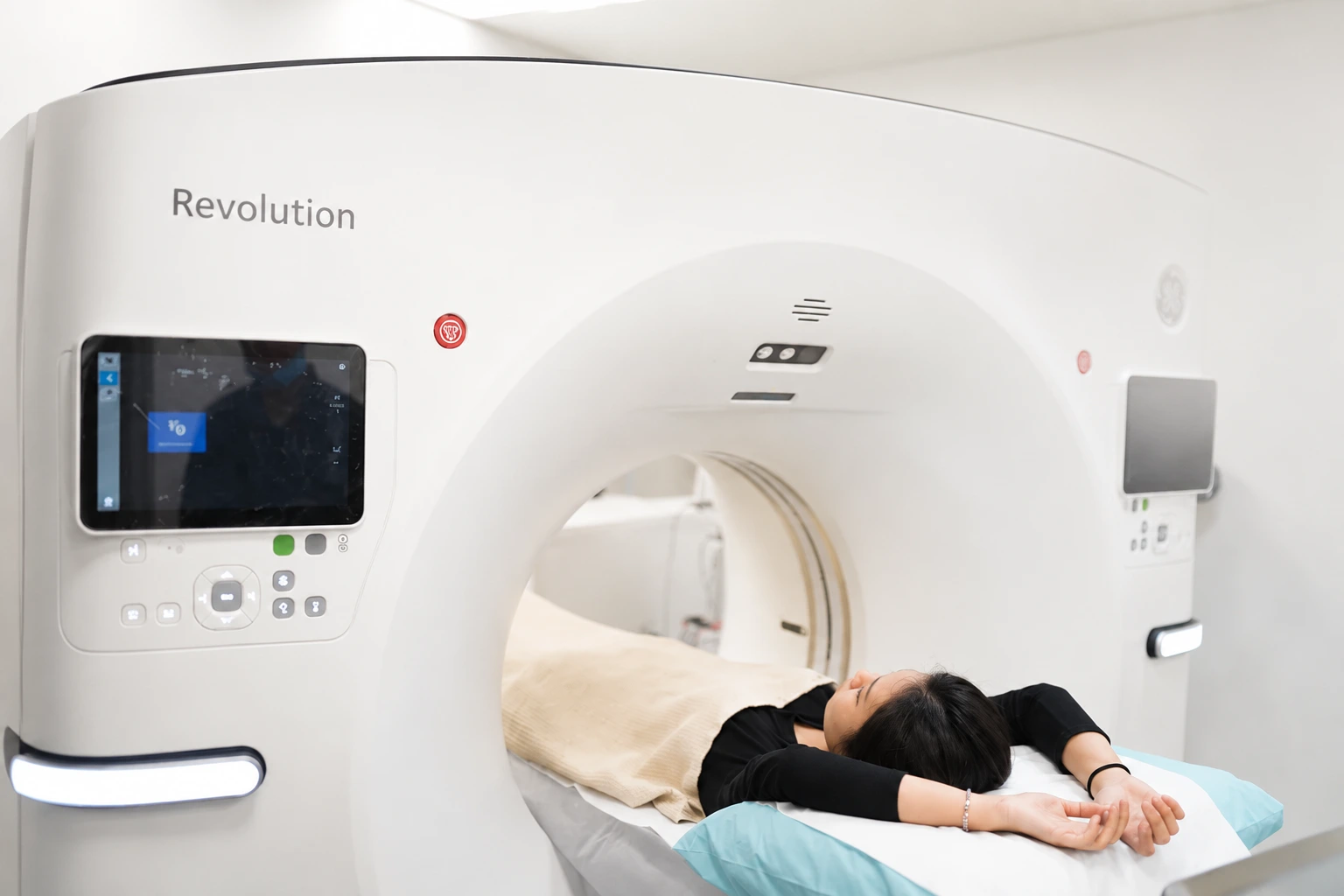
What a CT Coronary Angiogram Shows
By picturing the coronary arteries in detail, a CTCA helps a cardiologist assess:
- Whether the coronary arteries are narrowed or blocked by plaque, and how severe any narrowing is
- Both calcified and soft (non-calcified) plaque in the artery walls
- Whether chest pain or breathlessness is likely to be coming from the heart — and, importantly, it can reliably rule out significant coronary artery disease
- Anomalies of the coronary arteries, such as an unusual origin or course
- The state of coronary stents or bypass grafts in selected cases
- Whether you need further tests, medication or treatment — or reassurance that your arteries are clear
A CTCA is commonly used to investigate chest pain or breathlessness where coronary artery disease is a possibility, and to clarify a borderline calcium score or stress test. If you have sudden, severe or ongoing chest pain, do not wait for a scan — seek emergency care. Learn more about heart screening.
CT Coronary Angiogram vs Calcium Score vs Invasive Angiogram
These three tests look at the heart's arteries in different ways. A cardiologist chooses the one that fits your symptoms and risk.
| Test | How it works | What it shows | Typically used for |
|---|---|---|---|
| CT Calcium Score | Low-dose CT, no dye | Amount of calcified plaque, as a risk score | Risk assessment in people without symptoms |
| CT Coronary Angiogram (CTCA) | CT with contrast dye (non-invasive) | Detailed pictures of the artery walls and any narrowing | Assessing or ruling out disease when symptoms or risk warrant a closer look |
| Invasive Coronary Angiogram | Catheter and dye in a cath lab | The arteries in real time, with the option to treat | When severe disease is suspected or treatment such as a stent is likely |
A CTCA is particularly valuable because a normal scan makes significant narrowing very unlikely, so it can spare many people an invasive procedure. Where it shows important disease, an invasive coronary angiogram may still be advised so that treatment can follow.
Who Should Consider a CT Coronary Angiogram?
A CTCA is often considered if you:
- Have chest pain, breathlessness or other symptoms where coronary artery disease is a possibility, and are at low to intermediate risk
- Have an abnormal or borderline calcium score, stress test or ECG that needs clarifying
- Want a clear, non-invasive answer before deciding on further tests or treatment
- Need the arteries assessed but would prefer to avoid an invasive procedure if it can be safely avoided
A CTCA is not usually the first choice if severe disease is already strongly suspected or you are likely to need treatment, where an invasive coronary angiogram may be more appropriate. It is also not used for sudden, severe chest pain — that needs emergency assessment. A cardiologist will advise whether a CTCA is the right test for you.
What to Expect
The scan is straightforward, and the whole visit usually takes about 30–60 minutes.
- Beforehand. Avoid caffeine for a few hours, and tell us in advance about any kidney problems, contrast allergy, asthma, or if you are or could be pregnant. Your kidney function may be checked, as the test uses contrast dye.
- Steadying the heart rate. Clear images need a slow, regular heartbeat, so you may be given a medicine (a beta-blocker) before the scan, and sometimes a GTN spray under the tongue to widen the arteries. Your doctor may prescribe medication to slow your heart prior to the CT coronary angiogram.
- A small drip (cannula) is placed in a vein in your arm for the contrast, and ECG electrodes are attached so the scanner can time its images to your heartbeat.
- You lie on your back on the CT table and the bed moves through the ring-shaped scanner. The scanner is not a narrow tunnel. The dye is injected and you hold your breath for a few seconds — you may feel a brief warm flush, which passes quickly.
- The scan itself is over in seconds to minutes. You are observed briefly afterwards, and it helps to drink water to clear the dye. Most people return to normal activities the same day.
- Dr Paul Lim reviews and reports the images and explains the findings and any next steps during your consultation.
Why Do Your CT Coronary Angiogram with Us?
Reviewed by a Cardiologist
Your images are interpreted in context and explained by Dr Paul Lim, a Senior Consultant Cardiologist — not just a report.
A Non-Invasive Option
Detailed answers about your arteries without a catheter, sparing many people an invasive procedure.
A Plan, Not Just Images
We use the findings to shape a clear, personalised plan — from reassurance to medication or onward referral where needed.
Friendly & Caring Service
Our team takes the time to put you at ease and explain your results clearly, so you leave understanding what they mean.
Transparent Pricing
Our scan and consultation fees are published below, so you know the cost before you book.
On-Site CT Imaging
The scan is done at our CT suite at the Orchard clinic — no separate imaging-centre appointment.
Wondering if a CT coronary angiogram is right for you? Speak with Dr Paul Lim.
CT Coronary Angiogram Cost in Singapore
All fees are inclusive of GST. The scan is offered at our Orchard clinic.
| Service | Price |
|---|---|
| Test | |
| CT Coronary Angiogram (CTCA) | From S$1,384.30 |
| Related Test | |
| CT Calcium Score Risk score only, contrast-free | From S$403.30 |
| Consultation | |
| First Consultation with Cardiologist (Jurong) | S$130.80 |
| Follow-up Consultation with Cardiologist (Jurong) | S$98.10 |
| First Consultation with Cardiologist (Orchard) | S$218 |
| Follow-up Consultation with Cardiologist (Orchard) | S$163.50 |
| Also Available in a Heart Screening Package | |
| Comprehensive Heart Check-Up | S$1,578 |
| Full Heart Check-Up | S$1,688 |
A consultation with the cardiologist is required so the scan can be properly indicated and the results explained. You can consult Dr Paul Lim at either our Jurong or Orchard clinic; the CT scan itself is performed at our Orchard clinic. If you already have a referral letter from another doctor, the CT coronary angiogram can be arranged without a separate consultation. Package prices shown are all-inclusive — every test in that package plus the consultation and a results review with Dr Paul Lim. If you only need a risk score rather than detailed artery images, a standalone CT calcium score may be enough.
Book a CT Coronary Angiogram
Arrange a CT coronary angiogram at the Orchard clinic, next to the CT suite.
Send Us a Message

Where to Get a CT Coronary Angiogram in Singapore
CT imaging is carried out at the Orchard clinic. Consultations and follow-up are available at both locations.

Opening Hours
| Monday – Friday | 8:30 AM – 5:30 PM |
| Saturday | 8:30 AM – 12:30 PM |
| Sunday & Public Holidays | Closed |
By Appointment Only
CT Coronary Angiogram FAQ
What is a CT coronary angiogram?
A CT coronary angiogram (CTCA) is a CT scan of the heart taken after an injection of contrast dye. The dye fills the coronary arteries so the scanner can build detailed, three-dimensional pictures of the artery walls, showing whether plaque has narrowed or blocked them. It is a non-invasive test — no catheter is passed into the body — and in heart care the term CT angiogram usually refers to this coronary CT angiogram.
What does a CT coronary angiogram show, and how accurate is it?
It shows whether the coronary arteries are narrowed or blocked, how severe any narrowing is, and both calcified and soft (non-calcified) plaque in the artery walls. A CTCA is very accurate at ruling out significant coronary artery disease — a normal scan makes important narrowing very unlikely — which is why it is often used to assess chest pain in people at low to intermediate risk.
How is it different from a conventional (invasive) coronary angiogram?
A CT coronary angiogram is non-invasive: contrast is given through a small drip in the arm and the heart is photographed by a CT scanner. A conventional coronary angiogram is invasive: a thin catheter is passed from the wrist or groin to the heart and dye is injected directly into the arteries in a cath lab. The invasive test gives the most detail and allows treatment such as a stent during the same procedure, so it is preferred when severe disease is likely; a CTCA is an excellent non-invasive option to assess or rule out disease first. See the comparison above.
CT calcium score or CT coronary angiogram — which do I need?
A CT calcium score is a quick, contrast-free scan that measures calcified plaque and gives a risk score, mainly for people without symptoms. A CT coronary angiogram uses contrast to show the artery walls and any narrowing in detail, and is more suited to investigating symptoms such as chest pain. The right test depends on your symptoms and risk, which is why a cardiologist decides which one fits your situation.
Is a CT coronary angiogram safe? What about radiation and contrast dye?
A CTCA is a safe, well-established test for most people. It uses X-ray radiation and an iodine-based contrast dye. The dye is generally well tolerated, but it is used with care if you have reduced kidney function or a known iodine-contrast allergy, so your kidney function may be checked first. Modern scanners keep the radiation dose as low as possible. As with any test using radiation, it is recommended only when the result is likely to change your care.
How do I prepare for a CT coronary angiogram?
Avoid caffeine for several hours beforehand and bring a list of your medicines. To produce sharp images the heart needs to beat slowly and steadily, so you may be given a medicine (a beta-blocker) before the scan, and sometimes a GTN spray under the tongue to widen the arteries. You may be asked to fast for a few hours and to drink water so you are well hydrated. Tell us in advance if you have kidney problems, a contrast allergy, asthma, or are or could be pregnant.
How long does a CT coronary angiogram take?
The scan itself takes only a few seconds to a few minutes. Allow around 30 to 60 minutes for the whole visit, as time is needed to place the drip, settle your heart rate, and observe you briefly afterwards. Most people return to normal activities the same day.
Where is the CT coronary angiogram done?
The CT coronary angiogram is available at our Orchard clinic, where the scan is performed on site. Dr Paul Lim reviews the images and explains the findings during your consultation.
How much does a CT coronary angiogram cost in Singapore?
At our clinic a CT coronary angiogram is from S$1,384.30, inclusive of GST. A cardiologist consultation is also required (S$130.80 first / S$98.10 follow-up at Jurong; S$218 first / S$163.50 follow-up at Orchard, inclusive of GST). See the fee table above.
Who interprets the results?
Your scan is reviewed and reported by Dr Paul Lim, a Senior Consultant Cardiologist, who explains what the findings mean for your heart and what steps, if any, are recommended.