 Medically Reviewed By: Dr Paul Lim – MBBS, M.Med (Int Med), MRCP (UK), FAMS (Cardiology)
Cholesterol Test Lipid Panel & Lipid Profile in Singapore
A cholesterol test measures the fats in your blood: total cholesterol, LDL, HDL ratio and triglycerides, from a single sample. High cholesterol causes no symptoms, so the blood test is the only way to know where you stand. Due for a routine check? Talk to our friendly cardiologist Dr Paul Lim, who will patiently explain what your numbers mean and set targets that fit your own risk rather than a generic chart.
Reviewed by Dr Paul Lim Chun Yih
Senior Consultant Cardiologist

Clinical Experience
Your Cholesterol Result Is Interpreted by Dr Paul Lim
Senior Consultant Cardiologist & Cardiac Electrophysiologist
Dr Paul Lim is a Senior Consultant Cardiologist who reads your lipid panel against your full cardiovascular risk: your blood pressure, weight, smoking status, diabetes and family history. That context is what turns a set of numbers into a decision about whether anything needs doing. He completed advanced fellowship training at Barts Heart Centre, London under Singapore’s HMDP award.
- MBBS (Singapore)
- M.Med (Int Med)
- MRCP (UK)
- FAMS (Cardiology)
- Fellow, European Society of Cardiology (FESC)
- Fellow, American College of Cardiology (FACC)
- Fellow, Heart Rhythm Society (FHRS)
What Is a Cholesterol Test?
A cholesterol test, also known as a lipid panel or lipid profile, is a single blood sample that measures the fats circulating in your bloodstream.
Your body needs cholesterol to build cell walls, make hormones and produce vitamin D. The problem is quantity and balance. When there is more cholesterol in circulation than your body can clear, the surplus settles into artery walls and gradually narrows them. High cholesterol does not usually cause symptoms, so that narrowing can run for decades before anything shows.
What a Cholesterol Test Measures
Our Essential Lipid Profile reports five figures from one sample, named here as they appear on your report (what HDL, LDL and triglycerides each measure):
- Cholesterol, Total. The sum of everything in circulation. Useful at a glance, but it can hide a poor balance underneath, so it is rarely read on its own.
- Cholesterol, LDL, the fraction that deposits into artery walls and the figure most treatment decisions turn on. Lower is generally better.
- Cholesterol, HDL, which carries cholesterol back to the liver for disposal. Here, higher is better.
- Cholesterol / HDL Ratio. Total divided by HDL, in one number. It often tracks risk more closely than either figure alone, because it captures the balance between what is being deposited and what is being cleared.
- Triglycerides, a separate blood fat tied closely to diet, alcohol, weight and blood sugar. Usually the number that moves fastest when habits change.
One sample covers all five, with no separate needle or charge for each figure.
What Is a Normal Cholesterol Level?
These are the general adult reference points used in Singapore, in mmol/L.
| Measurement | Desirable | Borderline | Unfavourable |
|---|---|---|---|
| Cholesterol, Total | Below 5.2 | 5.2 – 6.1 | 6.2 or above |
| Cholesterol, LDL | Below 2.6 | 2.6 – 4.0 | 4.1 or above |
| Cholesterol, HDL | 1.6 or above | 1.0 – 1.5 (men) 1.3 – 1.5 (women) |
Below 1.0 (men) Below 1.3 (women) |
| Triglycerides | Below 1.7 | 1.7 – 2.2 | 2.3 or above |
| Cholesterol / HDL Ratio | Below 3.5 | 3.5 – 4.4 | 4.5 or above |
For HDL, the higher the number the better. It is the one row in the table that reads that way, because HDL clears cholesterol rather than depositing it.
Why these are reference points, not your targets
A reference range describes a population. Your target is a clinical decision. What counts as acceptable for you depends on your age, blood pressure, whether you smoke, whether you have diabetes, your family history, and above all whether you already have narrowing in your arteries. Someone who has had a heart attack is typically given an LDL target far below 2.6; someone in their thirties with no other risk factors may reasonably sit above it and need nothing done.
So two people can be handed an identical LDL figure and receive different advice, and both be right.
- Whether cholesterol is quietly accumulating in your artery walls, years before you would feel anything
- Your risk of heart attack and coronary artery disease
- Your risk of stroke from furring-up of the arteries
- Whether an inherited cholesterol disorder such as familial hypercholesterolaemia is likely, which changes both the urgency and who else in the family should be tested
- Whether treatment you are already taking is working, and by how much
- How aggressively to treat your other risk factors: blood pressure, blood sugar and weight
If you have never had yours measured, or it has been more than a few years, it is worth testing. It is one of the few major cardiovascular risks that is straightforwardly treatable once you know about it.
Who Should Have a Cholesterol Test?
Most adults benefit from a baseline reading. It becomes more pressing if you have:
- Reached your forties without a recent check, or your thirties with a family history behind you
- A family history of early heart disease or stroke in a first-degree relative (parent, sibling or child), affected before about 55 in men, 65 in women
- A relative with known familial hypercholesterolaemia or very high cholesterol
- Diabetes, high blood pressure, or a raised BMI
- A history of smoking, which lowers HDL and damages artery walls directly
- An existing diagnosis of high cholesterol, whether or not you are on medication
- Started, stopped or changed a cholesterol-lowering medicine in the past few months
Unsure whether you are due one? Dr Paul Lim can advise at a consultation and arrange the test where appropriate.
Do You Need to Fast for a Cholesterol Test?
Fasting is recommended, but it is not mandatory. It matters for some figures more than others.
- Total cholesterol, LDL and HDL barely move after a meal. A non-fasting sample gives a usable result for all three, and a check that happens today beats a fasting one you keep postponing.
- Triglycerides are the exception. They rise for several hours after eating and can read substantially higher on a full stomach. If your triglycerides are the figure in question, fast.
- Triglycerides also feed the LDL calculation. LDL is worked out from the other figures rather than measured directly. For most people that calculation holds up whether or not you have eaten. It becomes unreliable only once triglycerides are very high, around 4.5 mmol/L and above, and that is the situation where a fasting repeat may be suggested.
- Come fasted if other markers are being drawn at the same time. Fasting glucose, fasting insulin and HOMA-IR all require it, and they are commonly ordered alongside a lipid panel.
- Fasting means 9 to 12 hours, plain water only. An overnight fast with a morning appointment is the easiest way to do it.
- Keep taking your usual medicines unless you have been told otherwise. Stopping a cholesterol tablet before the test defeats the point, since the result would no longer reflect your treated level.
- Skip black coffee on the morning of the test, and alcohol the night before, which pushes triglycerides up on its own.
If you turn up having eaten, just say so. The result is still worth having, and it will be read accordingly.
What to Expect
The test itself is quick and straightforward.
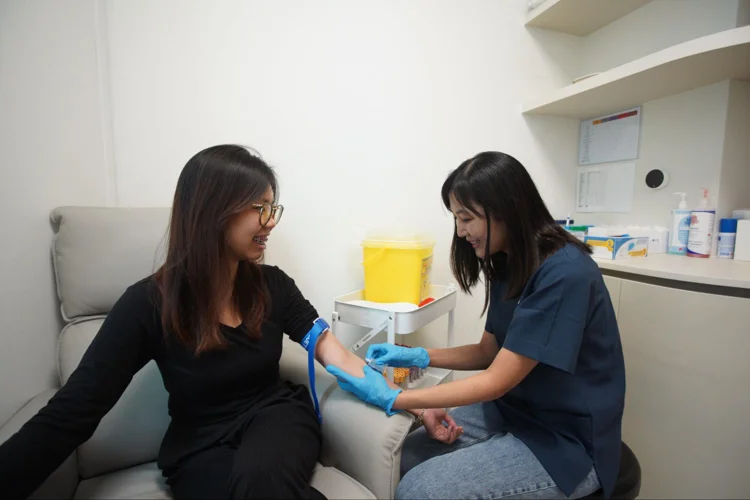
- A phlebotomist takes a single blood sample from a vein in your arm. It takes only a few minutes.
- You can return to normal activity straight away, including eating if you came fasted.
- The sample goes to the laboratory, where all five figures are worked out from it.
- Results are usually available within a few working days.
- Dr Paul Lim goes through them with you alongside your blood pressure, weight, family history and any symptoms.
- If anything needs acting on, he will set out your options and suggest when to re-test. For most people that means lifestyle first, with medication where the risk warrants it.
When a Standard Panel Is Not the Whole Picture
The five standard figures settle most cases. They fall short in two: when a reassuring panel sits behind a worrying family history, and when a result lands right on the line where treatment could go either way. These markers add information:
- Apolipoprotein B (ApoB) counts the actual number of cholesterol-carrying particles, which can be high even when LDL looks acceptable.
- Lipoprotein(a) is an inherited, largely fixed risk marker that no standard panel captures. Worth measuring once in a lifetime.
- hs-CRP flags low-grade inflammation in the blood vessels.
- A CT coronary calcium score answers a different question altogether: not how much risk you carry, but whether plaque has already formed.
Cholesterol tells you about risk; imaging tells you what has already happened. Where the two disagree, the imaging usually settles it. All of these are included in our heart screening packages, or can be added to a lipid panel individually.
Why Do Your Cholesterol Test with Us?
Interpreted by a Cardiologist
Your result is reviewed by Dr Paul Lim against your full risk picture, then explained — not handed to you as a printout with a highlighted row.
Five Figures, One Sample
Cholesterol Total, LDL, HDL, the Cholesterol / HDL Ratio and Triglycerides, from a single blood draw at S$21.80.
Flexible on Fasting
Fasting is preferred but not required, so you can be tested on whichever day suits you.
Further Markers on Hand
ApoB, Lp(a) and hs-CRP can be added to the same visit where your history suggests the standard panel will not settle the question.
Transparent Pricing
Our lipid panel and consultation fees are published below, so you know the cost before you book.
Two Locations
Available at our Jurong and Orchard clinics.
Holding a cholesterol report and unsure what it means? If you are concerned, or would simply like a second opinion, speak with Dr Paul Lim.
Cholesterol Test Cost in Singapore
All fees are inclusive of GST.
| Service | Price |
|---|---|
| Test | |
| Essential Lipid Profile Cholesterol Total, Cholesterol LDL, Cholesterol HDL, Cholesterol / HDL Ratio and Triglycerides | S$21.80 |
| Basic Heart Check-Up Package An all-inclusive screening: the lipid panel, a cardiologist consultation & review, a comprehensive blood panel with ApoB, hs-CRP and Lp(a), a resting ECG and a treadmill stress test | S$368 |
| Consultation | |
| First Consultation with Cardiologist (Jurong) | S$130.80 |
| Follow-up Consultation with Cardiologist (Jurong) | S$98.10 |
| First Consultation with Cardiologist (Orchard) | S$218 |
| Follow-up Consultation with Cardiologist (Orchard) | S$163.50 |
A consultation with the cardiologist is required so the test can be properly indicated and your result interpreted in the context of your overall cardiovascular risk.
If you are due a broader check, the Basic Heart Check-Up Package bundles the lipid panel with ApoB, hs-CRP, Lp(a), HbA1c and nine other markers, plus an ECG and a treadmill stress test, for S$368. Every tier includes the lipid panel. Compare them on the heart screening page. Fees for individual tests are listed in full on the cardiology fees page.
Book a Cholesterol Test
One blood sample, read by a cardiologist — arrange yours at either clinic.
Send Us a Message

Where to Get a Cholesterol Test in Singapore

Opening Hours
| Monday – Friday | 8:30 AM – 5:30 PM |
| Saturday | 8:30 AM – 12:30 PM |
| Sunday & Public Holidays | Closed |
By Appointment Only
Cholesterol Test FAQ
What is a cholesterol test?
A cholesterol test, also called a lipid panel or lipid profile, is a single blood test that measures the fats circulating in your blood. Our panel reports five figures: Cholesterol Total, Cholesterol LDL, Cholesterol HDL, the Cholesterol / HDL Ratio, and Triglycerides. Together these show how much cholesterol is available to deposit in your artery walls, and how much is being cleared away.
Do I need to fast before a cholesterol test?
Fasting is recommended but not mandatory. Total cholesterol, LDL and HDL change very little after a meal, so a non-fasting sample is accepted and still gives a usable result. Triglycerides are the exception, because they rise for several hours after eating. If your triglycerides matter to the decision being made, or you are being checked alongside a glucose or insulin test, come fasted for 9 to 12 hours with plain water only. Take your usual medicines unless told otherwise. More on fasting above.
What is a normal cholesterol level?
As a general guide for adults: total cholesterol below 5.2 mmol/L, LDL below 2.6 mmol/L, triglycerides below 1.7 mmol/L, and a total cholesterol to HDL ratio below 3.5. HDL runs the other way, because it clears cholesterol rather than depositing it: below 1.0 mmol/L in men or 1.3 mmol/L in women is unfavourable, and 1.6 mmol/L or above is the desirable level. These are reference points, not personal targets. What counts as acceptable for you depends on your age, blood pressure, smoking status, diabetes, family history and whether you already have heart disease. Someone who has had a heart attack is usually given a much lower LDL target than someone with no other risk factors. See the full table above.
How much does a cholesterol test cost in Singapore?
At our clinic the Essential Lipid Profile is S$21.80, inclusive of GST. A cardiologist consultation is also required (S$130.80 first / S$98.10 follow-up at Jurong; S$218 first / S$163.50 follow-up at Orchard, inclusive of GST). The panel is also included in every heart screening package, starting with the Basic Heart Check-Up Package at S$368. See the fee table above.
How often should I have my cholesterol checked?
Singapore's national guidance is a check once every three years from age 40, and that suits most healthy adults. Test earlier and more often if you are on cholesterol-lowering medication, have diabetes, have a family history of early heart disease in a first-degree relative, or your last result was raised. After a change to your treatment or lifestyle, a repeat at around three months shows whether it has worked. Dr Paul Lim will suggest an interval based on your own result and risk.
What does the Cholesterol / HDL Ratio mean?
It is your total cholesterol divided by your HDL, expressed as a single number. Because it weighs what is being deposited against what is being cleared away, it often tracks risk more closely than either figure on its own. Below 3.5 is desirable and 4.5 or above is raised. A total cholesterol that looks acceptable can still produce a poor ratio if HDL is low, which is one reason the panel is read as a whole rather than line by line.
Does a cholesterol test tell me if I have heart disease?
No. A cholesterol test measures risk, not damage. It tells you how likely you are to develop narrowing of the arteries over time, but it cannot show whether narrowing has already occurred. Where that question matters, a CT coronary calcium score detects calcified plaque directly, and a treadmill stress test or CT coronary angiogram may be appropriate if you have symptoms.
Can a cholesterol test be normal and my risk still be raised?
Yes. A standard panel does not measure lipoprotein(a), an inherited particle that raises risk independently, and it does not count the number of cholesterol-carrying particles, which apolipoprotein B measures. Someone with a strong family history of early heart disease can have an unremarkable lipid panel and still carry meaningful risk, which is why these additional markers are sometimes added.
How long do cholesterol test results take?
The blood draw itself takes a few minutes. The sample goes to the laboratory and results are usually available within a few working days, after which Dr Paul Lim goes through them with you alongside your blood pressure, family history and other risk factors.