 Medically Reviewed By: Dr Paul Lim – MBBS, M.Med (Int Med), MRCP (UK), FAMS (Cardiology)
Treadmill Stress Test Exercise ECG in Singapore
A treadmill stress test, also called an exercise ECG, records your heart's electrical activity, heart rate and blood pressure while you walk on a treadmill. Making the heart work harder reveals problems that may not show up at rest, such as reduced blood flow from narrowed arteries. Worried you will not keep up? The pace starts gently and you stop whenever you need to. Dr Paul Lim goes through the result with you afterwards, patiently.
Reviewed by Dr Paul Lim Chun Yih
Senior Consultant Cardiologist

Clinical Experience
Your Treadmill Stress Test Is Reviewed by Dr Paul Lim
Senior Consultant Cardiologist & Cardiac Electrophysiologist
Dr Paul Lim is a Senior Consultant Cardiologist who reviews and reports your treadmill stress test as part of a full cardiac assessment, and explains the findings to you directly. He completed advanced fellowship training at Barts Heart Centre, London under Singapore’s HMDP award.
- MBBS (Singapore)
- M.Med (Int Med)
- MRCP (UK)
- FAMS (Cardiology)
- Fellow, European Society of Cardiology (FESC)
- Fellow, American College of Cardiology (FACC)
- Fellow, Heart Rhythm Society (FHRS)
What Is a Treadmill Stress Test?
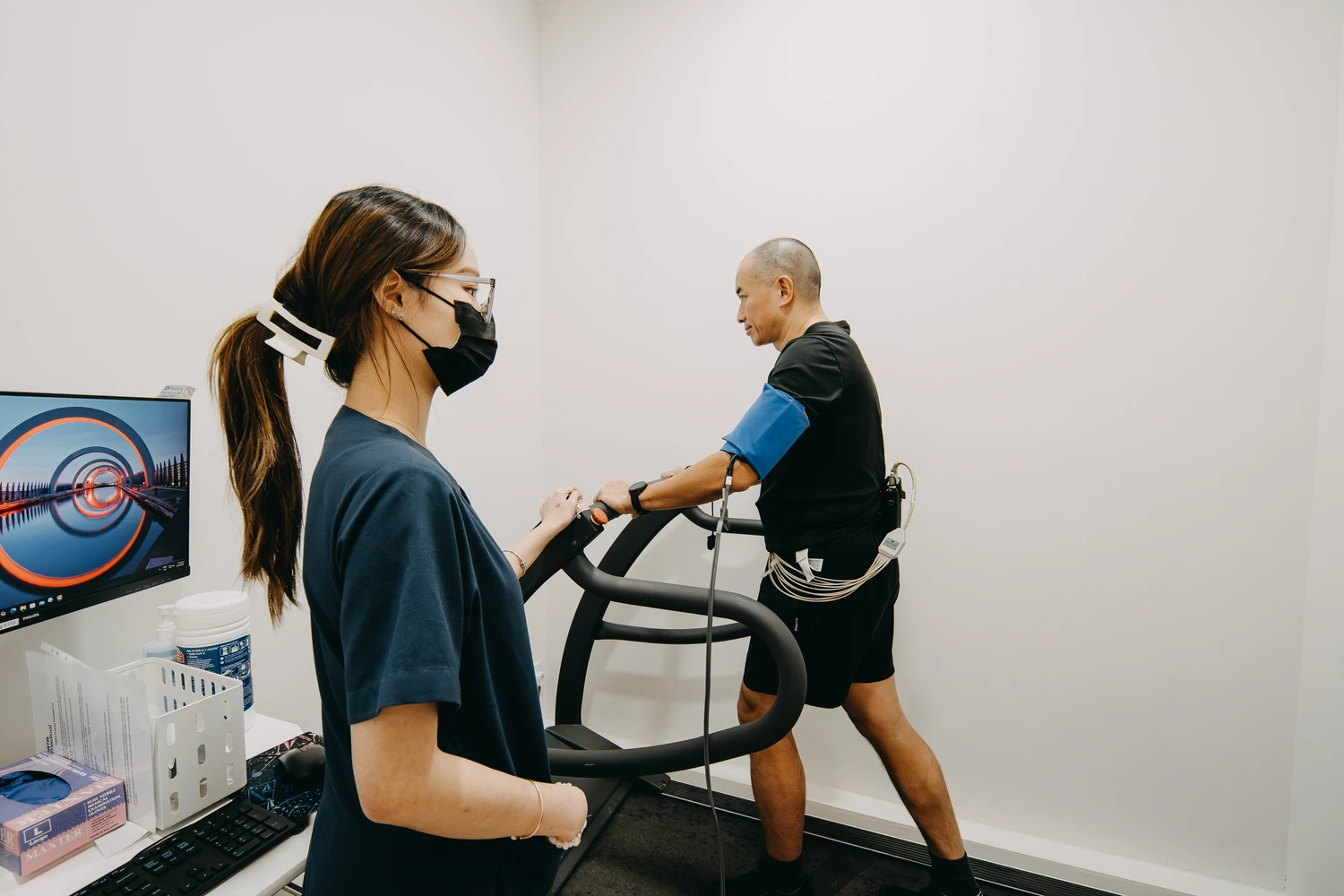
A treadmill stress test is an ECG recorded during exercise. Small sticky electrodes on the chest connect to an ECG machine while you walk on a treadmill, and a cuff measures your blood pressure at intervals. It is also known as an exercise stress test, an exercise tolerance test, or a TMT (treadmill test).
Unlike a resting ECG, which records your heart for only about ten seconds while you lie still, a treadmill test makes the heart work progressively harder. Most tests follow the standard Bruce protocol, in which the treadmill speeds up and tilts every three minutes. This stress on the heart can uncover signs of coronary artery disease and other problems that stay hidden at rest.
What a Treadmill Stress Test Shows
By recording your heart under exertion, a treadmill stress test helps a cardiologist assess:
- Whether your heart muscle is getting enough blood during exercise — a sign of narrowed arteries (coronary artery disease) or exercise-induced ischaemia
- Whether exercise brings on chest pain (angina), breathlessness or an irregular heartbeat
- How your heart rate and blood pressure respond to exertion and recovery
- Your overall exercise capacity and fitness for everyday activity
- Exercise-induced arrhythmias — rhythm problems that appear only when the heart works hard
- How well a known heart condition, or its treatment, is being controlled
It is commonly recommended to investigate chest pain or breathlessness on exertion, to assess the risk of coronary artery disease, and as part of a heart screening. A treadmill test looks at how the heart copes with exercise; if instead the concern is an intermittent rhythm at rest, a resting ECG, a 24-hour Holter monitor or a 2D echocardiogram may be used instead or alongside it. Learn more about irregular heartbeats.
What to Expect
A treadmill stress test is straightforward, and the whole appointment takes about 30–45 minutes.
- Come prepared to walk. Wear comfortable clothing and proper walking or running shoes, have only a light meal a few hours beforehand, and avoid caffeine and smoking on the day.
- Tell us your medicines. Bring a list of what you take — some heart medicines may be paused before the test, but only on your doctor's advice.
- A female professional attaches ECG electrodes to the chest and fits a blood pressure cuff. Men with a hairy chest may have small areas shaved for good contact. A resting ECG and blood pressure are recorded first.
- You then walk on the treadmill, which gradually speeds up and inclines every three minutes (the Bruce protocol). Your ECG, heart rate and blood pressure are watched the whole time.
- The walking usually lasts about 6–12 minutes and continues until you reach a target heart rate — a set share of your age-predicted maximum heart rate — develop symptoms, or the team decides to stop. You can ask to stop at any point.
- A short recovery period follows while monitoring continues, then Dr Paul Lim reviews and reports the findings and explains what they mean.
Why Do Your Treadmill Stress Test with Us?
Female Professionals
The treadmill stress test is performed by female healthcare professionals.
Reviewed by a Cardiologist
Your recording is interpreted and reported by Dr Paul Lim, a Senior Consultant Cardiologist.
Closely Monitored
Your heart rate, rhythm and blood pressure are watched continuously throughout the test for your safety.
Friendly & Caring Service
Our team takes the time to put you at ease and explain your results clearly, so you leave understanding what they mean.
Transparent Pricing
Our test and consultation fees are published below, so you know the cost before you book.
Two Locations
Available at our Jurong and Orchard clinics.
Think you may need a treadmill stress test? Speak with Dr Paul Lim.
Treadmill Stress Test Cost in Singapore
All fees are inclusive of GST.
| Service | Price |
|---|---|
| Test | |
| Treadmill Stress Test (Exercise ECG) | S$218 |
| Heart Screening Packages (treadmill stress test included) | |
| Basic Heart Check-Up Package Cardiologist consultation & review, a comprehensive blood panel, a resting ECG and a treadmill stress test | S$368 |
| Plus Heart Check-Up Package Everything in Basic, plus a transthoracic echocardiogram | S$628 |
| Advanced Heart Check-Up Package Everything in Plus, plus a CT calcium score | S$878 |
| Consultation | |
| First Consultation with Cardiologist (Jurong) | S$130.80 |
| Follow-up Consultation with Cardiologist (Jurong) | S$98.10 |
| First Consultation with Cardiologist (Orchard) | S$218 |
| Follow-up Consultation with Cardiologist (Orchard) | S$163.50 |
A consultation with the cardiologist is required so the test can be properly indicated and the results explained. If you already have a referral letter from another doctor, the treadmill stress test can be arranged without a separate consultation. A treadmill stress test is also included in the Basic, Plus and Advanced heart screening packages shown above (the Comprehensive and Full tiers use a CT coronary angiogram instead).
Book a Treadmill Stress Test
Arrange an exercise ECG to see how your heart behaves under exertion.
Send Us a Message

Where to Get a Treadmill Stress Test in Singapore
Opening Hours
| Monday – Friday | 8:30 AM – 5:30 PM |
| Saturday | 8:30 AM – 12:30 PM |
| Sunday & Public Holidays | Closed |
By Appointment Only
Treadmill Stress Test FAQ
What is a treadmill stress test?
A treadmill stress test, also called an exercise ECG or exercise stress test, records your heart's electrical activity, heart rate and blood pressure while you walk on a treadmill. As the speed and incline rise, your heart has to work harder, which can reveal problems — such as reduced blood flow from narrowed arteries — that may not show up while you are at rest.
How is a treadmill stress test different from a resting ECG?
A resting ECG records your heart for only about ten seconds while you lie still. A treadmill stress test records the ECG continuously while you exercise, so it can show how your heart copes under exertion. Some problems, such as exercise-induced angina or arrhythmias, only appear when the heart is working hard, and these can be missed by a resting ECG.
What does a treadmill stress test show?
It can show whether your heart muscle is getting enough blood during exertion (a sign of coronary artery disease), whether exercise brings on chest pain, breathlessness or an irregular heartbeat, how your heart rate and blood pressure respond to exercise, and your overall exercise capacity. It is also used to check how well a known heart condition or its treatment is being controlled.
How long does a treadmill stress test take?
Allow about 30 to 45 minutes for the whole appointment. The walking portion itself usually lasts around 6 to 12 minutes, following the standard Bruce protocol in which the treadmill speeds up and inclines every three minutes, followed by a short recovery period while monitoring continues.
How do I prepare for a treadmill stress test?
Wear comfortable clothing and proper walking or running shoes. Have only a light meal a few hours beforehand, and avoid caffeine and smoking on the day. Bring a list of your current medicines — some heart medicines may be paused beforehand, but only on your doctor's advice. Men with a hairy chest may have small areas shaved so the electrodes stick well.
Is a treadmill stress test safe, and does it hurt?
The test is painless and uses no radiation — it simply records your heart's own electrical signals. It is very safe for the great majority of people. Because it deliberately makes the heart work hard there is a small risk, so your heart rate, rhythm and blood pressure are monitored continuously throughout and the test is stopped at once if needed.
Will a woman perform the test?
Yes. The treadmill stress test is performed by female professionals.
How much does a treadmill stress test cost in Singapore?
At our clinic a treadmill stress test is S$218, inclusive of GST. A cardiologist consultation is also required (S$130.80 first / S$98.10 follow-up at Jurong; S$218 first / S$163.50 follow-up at Orchard, inclusive of GST). See the fee table above.
Who interprets the results?
The recording is reviewed and reported by Dr Paul Lim, a Senior Consultant Cardiologist, and the findings are explained to you during your consultation.