Xanthelasma
Soft, flat, yellowish patches on or around the eyelids, usually near the inner corner.
Often associated with raised cholesterol, though it can occur with normal levels too. Worth a blood test either way.
 Medically Reviewed By: Dr Paul Lim – MBBS, M.Med (Int Med), MRCP (UK), FAMS (Cardiology)
High cholesterol almost never causes symptoms — which is precisely why it goes unnoticed for years. Looking for signs you might have missed? Dr Paul Lim will go through your results with you, unhurried, and tell you what they mean for your heart.
Dr Paul Lim Chun Yih
Senior Consultant Cardiologist & Electrophysiologist
Basic Heart Check-Up — S$368 (NETT, incl. GST). Full lipid panel, plus ApoB and Lp(a) — which a standard cholesterol test does not measure. Consultation and results review included.
Cholesterol circulates in the blood. It does not press on a nerve, stretch an organ or inflame a joint, so there is nothing for the body to report — high cholesterol does not usually cause symptoms.
Three things are worth separating: the visible signs that do exist, the symptoms of damage already done, and the things people wrongly attribute to cholesterol.
When cholesterol is very high, or high for a long time, it can deposit in the skin and eyes. These are painless and harmless in themselves. Their value is as a flag: they are a reason to have a blood test, not a diagnosis on their own.
Soft, flat, yellowish patches on or around the eyelids, usually near the inner corner.
Often associated with raised cholesterol, though it can occur with normal levels too. Worth a blood test either way.
A pale grey or white ring around the outer edge of the iris.
Common and generally not significant over about 50. Under 45 it more often points to a genuinely raised level.
Firm thickening over the knuckles, the back of the hand, or the Achilles tendon.
Strongly associated with familial hypercholesterolaemia. This one warrants prompt assessment.
Crops of small yellowish bumps, often on the buttocks, elbows or knees.
Usually reflects very high triglycerides rather than cholesterol, and can accompany poorly controlled diabetes.
Most people with raised cholesterol have none of these. If you have never had yours checked, or it has been a few years, it is worth testing.
These are not symptoms of cholesterol. They are symptoms of what cholesterol has already done — deposits building in artery walls over years, narrowing the vessels that supply the heart, brain and legs. By the time these appear, the process has been running quietly for a long time.
Call 995 or go to the nearest A&E immediately if you have chest pain or pressure lasting more than a few minutes, chest discomfort with breathlessness, sweating or nausea, or signs of a stroke. Remember F.A.S.T.: Face drooping, Arm weakness, Speech difficulty, Time to call 995.
These come up often, and it is worth being direct about them. There is no good evidence that raised cholesterol on its own produces:
None of this means those symptoms should be ignored — they should be investigated on their own terms. It means that treating cholesterol is unlikely to resolve them, and that a normal cholesterol result does not explain them away.
Already been given a cholesterol result you would like explained? Dr Paul Lim will go through it with you.

Senior Consultant Cardiologist & Cardiac Electrophysiologist
Dr Paul Lim is a Senior Consultant Cardiologist who assesses cardiovascular risk alongside his subspecialty in heart rhythm disorders. He reads a cholesterol result together with your blood pressure, family history, calcium score where relevant, and any symptoms. He completed advanced fellowship training at Barts Heart Centre, London under Singapore’s HMDP award.
Cholesterol is a waxy, fat-like substance your body needs. It builds cell walls, makes hormones and helps produce vitamin D. Your liver makes most of what you need; the rest comes from food. The problem is not cholesterol itself — it is having more of the wrong kind circulating than your body can clear.
Excess cholesterol works its way into the walls of your arteries and forms deposits called plaque. Over years the artery narrows and stiffens. If a plaque ruptures, a clot can form and block the vessel outright — which is what a heart attack or most strokes actually are. This is why the condition is taken seriously despite producing no symptoms: the damage is cumulative and silent.
A cholesterol blood test, known as a lipid panel, reports several figures rather than one. LDL is the fraction that deposits in artery walls and the figure most treatment decisions turn on. HDL carries cholesterol back to the liver for disposal, so here a higher number is the better one. Triglycerides are a separate blood fat, tied closely to diet, alcohol, weight and blood sugar. Total cholesterol sums everything up, which makes it useful at a glance and easy to misread on its own.
What counts as high for you is not a single universal threshold. It depends on your age, blood pressure, whether you smoke, whether you have diabetes, and your family history. Two people can be handed the same LDL figure and reasonably be given different advice, which is why it is worth going through your report with a cardiologist rather than comparing it against a chart. The cholesterol test page sets out each measurement in full, the general reference ranges, and what the test costs.
It is usually a combination of what you inherit and how you live. Neither alone tells the whole story, which is why slim, active people are sometimes surprised by their results.
Some people are born with it. In familial hypercholesterolaemia (FH), an inherited change means the body cannot clear LDL cholesterol efficiently, so levels are high from childhood regardless of diet or fitness. It is passed directly from parent to child.
Consider it if any of the following apply:
Tendon thickening makes FH very likely when it is there, but most people with FH never develop it, so smooth knuckles and clear eyes rule nothing out. The cholesterol reading and the family history carry far more weight than anything visible.
FH is worth identifying because it responds to treatment, and because a diagnosis has direct implications for your immediate family — each first-degree relative has roughly a one-in-two chance of carrying it.
Raised cholesterol is common here and is not confined to any one group. Risk of coronary disease at a given cholesterol level differs across Singapore’s ethnic groups, and central obesity carries cardiovascular risk at a lower body mass index in Asian populations than the thresholds derived from Western data. In practice that means a normal-looking BMI is not by itself a reason to skip the test. There is a national overview of raised blood lipids in Singapore; our own summary of local figures is in heart health statistics for Singapore.
Since there is nothing to feel and usually nothing to see, diagnosis rests on a blood test. It is quick, routine, and the results are straightforward to act on.
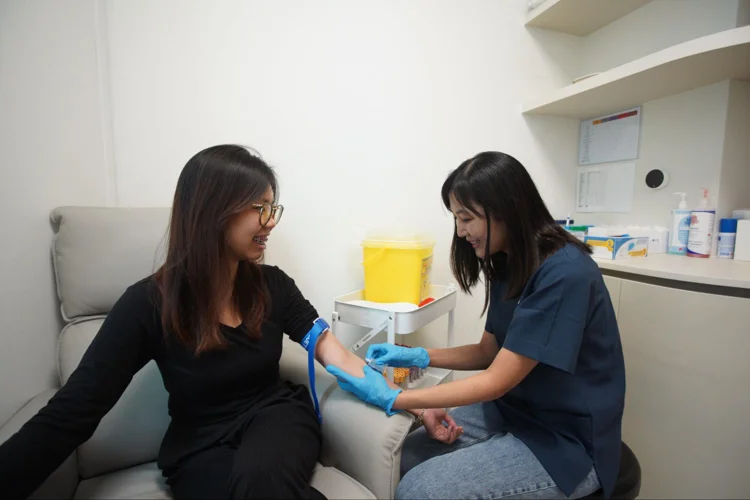
One blood sample measures total cholesterol, LDL, HDL and triglycerides. Full detail on what each figure means, whether you need to fast and what it costs is on the cholesterol test page. It is included in every heart screening package, starting with the Basic tier.
Your result is read alongside your blood pressure, weight, smoking status, diabetes status, family history and any symptoms. This is the step that turns a number into a decision.
Two situations call for more than the standard panel: your results look unremarkable but your family history does not, or your numbers sit close to the line where the decision could reasonably go either way. These add information:
Cholesterol tells you about risk. Imaging tells you what has already happened. A CT coronary calcium score detects calcified plaque in the heart’s arteries and is often the single most useful test for someone weighing up whether to treat. Where symptoms are present, a treadmill stress test or CT coronary angiogram may be appropriate.
Costs for individual tests and consultations are listed on the cardiology fees page.
A raised reading is not an emergency and not a verdict. It is information, arriving early enough to act on.
For many people this is enough on its own. The changes that move cholesterol most:
Cholesterol-lowering medication is well established and, where it is warranted, it works. But it is not the automatic answer to a single raised number. Whether it is worthwhile for you depends on your overall cardiovascular risk: your level, your age, your blood pressure, whether you smoke, whether you have diabetes, your family history, and what any imaging shows. That is then weighed against what lifestyle change alone is realistically likely to achieve in your case.
Some people can bring their numbers down without medication and should be given a fair chance to. Others will not get there on diet and exercise alone, particularly those with an inherited cause or existing arterial disease, and delaying is not in their interest. That judgement is what a consultation is for.
Cholesterol rarely travels alone. High blood pressure, raised blood sugar, excess weight and smoking compound each other, and addressing them together achieves considerably more than treating any one in isolation. This is also why a cholesterol result is best read as part of a broader assessment rather than as a standalone score.
A raised reading usually starts with your family doctor, and often goes no further. A cardiologist is worth seeing when the number sits inside a wider risk picture: what it means for your arteries, whether medication is worthwhile in your case, and whether anything has already changed that a blood test alone will not show.
Consider a review if your LDL is markedly high, if there is heart disease or sudden cardiac death in your family before 50, or if raised cholesterol arrives alongside high blood pressure, diabetes or smoking. The same goes if a statin has not suited you, if you are unsure whether to start one, or if you have chest tightness or breathlessness on exertion.
See Dr Paul Lim to have your cholesterol results interpreted alongside the rest of your cardiovascular risk.
| Monday – Friday | 8:30 AM – 5:30 PM |
| Saturday | 8:30 AM – 12:30 PM |
| Sunday & Public Holidays | Closed |
By Appointment Only
The questions people most often arrive with about cholesterol symptoms, testing and treatment.
In most people, no. High cholesterol does not cause pain, and you cannot feel it circulating in your blood. It is detected with a blood test, not by how you feel. The exceptions are visible cholesterol deposits in the skin and eyes, which appear mainly when levels are very high or inherited, and the symptoms of damage that cholesterol has already caused to the arteries — such as chest tightness on exertion.
No. There is no sensation associated with a raised cholesterol level itself. People often describe feeling tired, heavy or foggy and wonder whether cholesterol is the cause — it usually is not. The only reliable way to know your level is a blood test.
For most people the first sign is a number on a blood test result, not a physical symptom. When there is a physical sign, it is most often a visible deposit — a soft yellowish patch on the eyelid (xanthelasma) or a pale ring around the edge of the coloured part of the eye (corneal arcus). In some people the first sign is unfortunately a heart attack or stroke, which is the reason screening exists.
Two signs appear near the eyes. Xanthelasma are soft, flat, yellowish patches on or around the eyelids, usually near the inner corner. Corneal arcus is a pale grey or white ring around the outer edge of the iris. Neither is painful and neither affects vision. Corneal arcus is common and generally not significant over the age of about 50, but under 45 it is more likely to point to a genuinely raised level and is worth a blood test.
There is no good evidence that raised cholesterol on its own causes tiredness, headaches or dizziness. These are common symptoms with many other explanations. They are still worth investigating — but through a proper assessment of what is actually causing them, rather than assuming cholesterol is responsible.
The condition itself is silent in both. What differs is the pattern of risk. Cholesterol levels in women often rise after menopause as oestrogen falls, so a reading that was normal in the forties can change in the fifties. When cholesterol has already narrowed the arteries, women are somewhat more likely than men to experience symptoms as breathlessness, unusual fatigue, nausea or jaw and back discomfort rather than classic central chest pain.
Yes. Being slim, young or physically active does not rule it out. A significant proportion of cholesterol level is inherited rather than eaten, and familial hypercholesterolaemia is present from birth. If a parent or sibling had a heart attack or stroke at a young age, that is a reason to check your own level regardless of your build or age.
A blood test called a lipid panel measures total cholesterol, LDL, HDL and triglycerides. It is a routine test, takes a few minutes, and is included in every heart screening package at the clinic. Many modern lipid panels no longer require fasting, though you may be asked to fast depending on what else is being measured at the same time.
It is usually a combination of what you inherit and how you live. Contributors include a diet high in saturated fat, physical inactivity, excess weight around the middle, smoking and excessive alcohol. Type 2 diabetes, an underactive thyroid, and kidney or liver disease can raise it, as can some medications. Familial hypercholesterolaemia is a genetic cause that produces markedly high levels from a young age.
It is not dangerous in the moment — there is no crisis to react to on the day you are told. The risk accumulates over years, as cholesterol deposits narrow and stiffen the arteries supplying the heart, brain and legs. That process is what leads to heart attack, stroke and peripheral arterial disease. Because it develops slowly and silently, it is also one of the more modifiable cardiovascular risks once identified.
Cholesterol levels respond well to change. Diet, regular activity, weight loss, stopping smoking and reducing alcohol all lower it, and for many people that is sufficient. Where the level is driven largely by genetics, lifestyle alone may not bring it far enough down and medication is considered. Arterial narrowing that has already formed is not simply undone, but its progression can be slowed considerably.
Not necessarily, and it is not a decision made from one number. Whether medication is worthwhile depends on your overall cardiovascular risk: your level, your age, blood pressure, whether you smoke, whether you have diabetes, and your family history. That is weighed against what lifestyle change alone is likely to achieve for you. It is a conversation to have at a consultation, with your own results in front of you.
For most healthy adults, every few years from around the age of 40 is a reasonable starting point. Check earlier and more often if you have a family history of early heart disease, diabetes, high blood pressure, if you smoke, or if a previous reading was raised. If you are already on treatment, your doctor will set the interval.
Familial hypercholesterolaemia is an inherited condition in which the body cannot clear LDL cholesterol from the blood efficiently, so levels are high from childhood. It is passed directly from parent to child, and it substantially raises the risk of early heart disease if untreated. Clues include very high readings and a strong family history of heart attack or stroke before the age of 60. Tendon thickening over the knuckles or Achilles tendon is another clue, but most people with FH never develop it, so its absence does not rule the condition out. It is worth identifying because it is treatable and because a diagnosis has implications for close relatives.
A standard lipid panel is the right starting point for almost everyone. Where the picture is unclear, such as a strong family history alongside an unremarkable panel, or borderline numbers where the decision could go either way, additional markers like apolipoprotein B, lipoprotein(a) or hs-CRP can add useful information. A CT coronary calcium score answers a different question: whether deposits have already formed in the heart’s arteries.